

Rightly Divided: How, then may we determine the proper interpretation of Scripture?
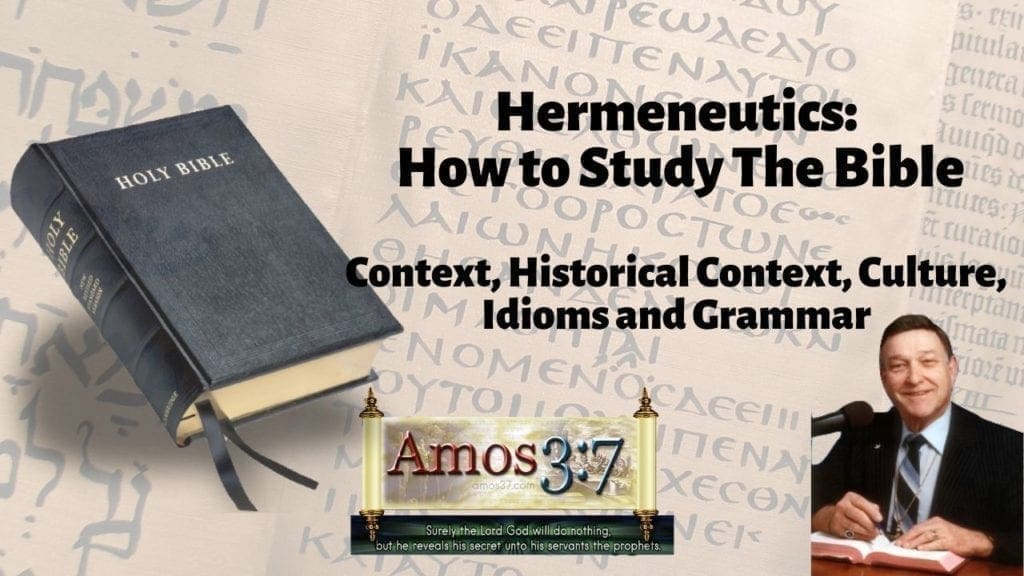
The science of Biblical Hermeneutics – in all it’s varied “schools” – seeks to provide a methodology to answer that question.
Skeptics often ask me, “If the Bible is God’s Word, why are there so many different interpretations of what He supposedly said?”
Understanding Error & Hermeneutic Session 01
Resurrection Fallacies Dr. Walter Martin
Collapsing Context By Dr. Walter Martin
Understanding Proper Context Dr. Walter Martin
Worldview Confusion Dr Walter Martin
Faulty & Sloppy Interpretation Methods Dr Walter Martin
What is Biblical Hermeneutics Additional Notes PDF download
An Introduction
Those who accept the Bible as the Word of God believe that God has spoken to us unambiguously. We believe that there is only one “right” interpretation of any given Biblical passage – the meaning God intended when He “breathed” His word into the human author. If this view is correct, then of the many “different interpretations” skeptics refer to, only one is valid. That is, while a particular passage may have many applications, it must have only one meaning – the one the author (through inspiration of the Holy Spirit) intended.
How, then, may we determine the proper interpretation of Scripture? The science of Biblical Hermeneutics – in all it’s varied “schools” – seeks to provide a methodology to answer that question.
Biblical hermeneutics is the science that teaches the principles and methods of interpreting the Word of God. Proper hermeneutics provides us with tools to help ensure that we are basing our interpretations on the truth as God has revealed it, while avoiding error to the greatest degree possible.
Sound hermeneutic principles are not optional for the true disciple of Christ. The Apostle Paul enjoins us to “be diligent to present yourself approved to God as a workman who does not need to be ashamed, accurately handling the word of truth” (2 Timothy 2:15). The purpose of this paper is to provide a brief introduction to some basic hermeneutical principles – principles that we strive to adhere to in the commentaries on this website. A short bibliography and links to resources for additional research are provided at the end of this paper.
The Bible Affirms its Own Clarity
The Apostle Peter reminded his readers that some things in the writings of the Apostle Paul are “hard to understand” (2 Peter 3:15-16). We must therefore admit that not all parts of Scripture are able to be easily understood. However, it would be a grave error to conclude that all Scripture is obscure or that it requires years of study to adequately interpret it. The Bible itself – directly and indirectly – proclaims that it is written in such a way that believers, regardless of their education or mental acumen, may read and understand its pages. Indeed, Peter himself in the passage just quoted, does not say the difficult passages in Paul’s letters are impossible to understand – only “hard.”
Moses tells the people of Israel:
And these words I command you this day shall be upon your heart; and you shall teach them diligently to your children, and shall talk of them when you sit in your house, and when you walk by the way, and when you lie down, and when you rise” (Deuteronomy 6:6-7 RSV).
The clear implication is that all the people of Israel understood Moses’ words clearly. They would have to, if they were to teach these words to their children and discuss them regularly. The Psalmist says: “The unfolding of your words gives light; it imparts understanding to the simple” (Psalms 119:130 RSV). This should be a great encouragement to all believers – for if the “simple” (those who lack intellectual ability and sound judgment) can be made wise by God’s Word, it must first be understandable by them.
Some may wish to introduce 2 Peter 1:20 here: “No prophecy of Scripture came about by the prophet’s own interpretation”. Those who advocate that proper interpretation of Scripture is the sole province of the Church, or an anointed class of specially gifted leaders, press this verse as proof against individual interpretation by ordinary believers. The context of this verse argues against such a view. Peter has just made reference to the Transfiguration, which confirmed for those present the exalted status of the Son of God.
He says that his readers may be even more sure of Christ’s exaltation because they have the “prophetic word” (verse 19) – that is, written Scripture. He then explains why they may be more sure, even beyond a divine vision such as Peter was graced to see. The prophecy of Scripture – the declaring forth and recording of God’s Word – is not a matter of the prophet’s own “interpretation” of what God intended, but rather was the very Word of God Himself:: “no prophecy was ever made by an act of human will, but men moved by the Holy Spirit spoke from God” (verse 21). Thus, it is the creation of Scripture that is in view here, not the subsequent interpretation of it.
The New Testament writers often say that the reader’s moral state, not their intellectual state, prevents clear understanding of Scripture (cf., 1 Corinthians 2:14; 2 Corinthians 3:14-16; 4:3-4; Hebrews 5:14; James 1:5-6, etc.). Paul affirms the clarity of his words to the church at Corinth: “We write you nothing but what you can read and understand” (2 Corinthians 1:13). It is helpful to keep in mind that Paul’s letters were read to the entire church – to all present, even Greeks with little understanding of Jewish culture and unbelievers. Scripture is able to be understood by all – by unbelievers who read it sincerely seeking salvation, and by believers who read it seeking God’s help in understanding it. This is because in both cases the Holy Spirit combats the influence of sin which otherwise would make the wisdom of God appear obtuse to the natural man (1 Corinthians 2:14).
Cultural / Historical Perspective
When attempting to interpret Scripture, it is important to remember that the Bible was written in a specific culture – the ancient Jewish or “Semitic” culture of the Near East. Our culture – the postmodern Western culture – is vastly different from that of the authors of Scripture; we will sometimes find big differences in what we take to be “givens” in a specific area of knowledge and what the Biblical writers took as their “givens.” The Biblical writer’s history, culture, customs, environment, and language are diverse and removed from our culture and way of life.
We will find that great gaps exist between Eastern and Western culture; therefore, we need some help in bridging these gaps. We, as Westerners, will find ourselves separated from the Bible culturally, geographically, historically, and especially by language.
On the other hand, we believe God’s Word to be universal in meaning and application. We believe the Holy Spirit will reveal all truth to us, particularly with regard to the Bible. Many in the New Testament churches did not understand the Hebrew of the Old Testament, yet the Apostles expected them to understand the truth of the Old Testament scriptures when translated into Greek. Does this mean that we may safely ignore the cultural, historical, and language differences between us and the Biblical writer? I don’t believe it does, any more than we may rely on the Holy Spirit to teach us to speak or read or use logic. The Holy Spirit inspired the Biblical authors and illuminates God’s Word to those who earnestly seek its truth, but interpretation is properly the responsibility of individual Christians.
Paul describes the one who “rightly divides” the Word of Truth as a “workman”; thus proper interpretation comes through effort. Paul is writing to Timothy who was apparently gifted as a teacher, and certainly the Holy Spirit provides the church gifted teachers to help us better understand God’s Word, but Scripture is quite clear that we are all to read, study, and meditate upon God’s Word (cf., 1 Timothy 4:13; Proverbs 4:2; Psalm 1:1-3) – and this can only be done if we are prepared to be “workmen” and to test the things our teachers teach us against the pure measure of Scripture (1 Thessalonians 5:21).
What This Text Means to Me…
The view that all one must do is pray and read the Bible, and the Holy Spirit will provide the proper interpretation, or the view that one’s own, idiosyncratic interpretation of Scripture is just as valid as that of any other (“what this text means to me…”) renders the interpretation non-falsifiable. That is, if I say that the Holy Spirit provided me with the interpretation, or my interpretation, it is impossible for anyone to demonstrate that I have wrongly divided the Word. The “truth” I have arrived at is self-contained and ultimately incommunicable to you.
You will have to “experience” the same personal revelation, and even then, we may wonder whether our two experiences were really identical, or whether subtle differences may affect our interpretation. This hermeneutic methodology (or really lack of methodology) provides ample opportunity for me to twist Scripture to my own destruction, and to that of any others who would follow my interpretation (2 Peter 3:16).
The noble-minded Bereans in Acts 17 diligently searched the Scriptures, seeking to learn if the Gospel Paul was preaching to them was true. We may be certain that they held a common view – an “orthodox” interpretation of the Scriptures they read – by which they measured what Paul was saying. This interpretation, if contemporary Rabbinic writings are any measure, carefully applied principles like the ones we shall be considering.
It may be helpful to define some terms and concepts that pertain to hermeneutics.
Some Working Definitions: Revelation, Inspiration, Illumination, and Interpretation
Revelation
The act of God the Holy Spirit unveiling or uncovering truths that man through his own intellect, reason, and investigation cannot discover for himself.
Inspiration
The Holy Spirit’s act of superintending the writing of the truths God wants man to know. I use the term “superintending” to indicate that God uses the author’s personality, experience, vocabulary, and writing style. Inspiration is divine guidance, not dictation. By superintending the Biblical authors, God ensures that His revelation is recorded accurately and without error.
Illumination
The act of the Holy Spirit to convict the reader of the truth of Scripture and lead the reader to an “extra-exegetical” understanding of the general truth of God’s Word.. By “extra-exegetical,” I don’t mean to imply that the Holy Spirit is not involved in the process of exegesis (the interpretation of a given passage), but that illumination is properly understood to be an aspect of the convicting role of the Spirit, to soften the heart. God speaks to us through His written Word. The Holy Spirit helps us to know that what we are reading is indeed God’s Word.
Interpretation
The prayerful application of Scriptural principles by which the illuminated student of God’s Word comes to an understanding of Scripture that corresponds as closely as humanly possible to the inspired meaning. The Holy Spirit reveals general truths about God; the student, convicted of these general truths, applies hermeneutic principles to arrive at the proper meaning of specific passages.
Schools of Biblical Interpretation
Through the centuries, people have recognized the value in using principles for interpretation. But humans, as we are, have developed many different principles and methodologies. Here’s a brief summary of the more popular hermeneutic “schools”
The Allegorical Schools of Interpretation (Warning-Subjective)

This method of interpretation developed among Hellenized Jews and Christians, strongly influenced by Platonic philosophy. Clement of Alexandria and Origen are two early church “fathers” who viewed Scripture, particularly the Old Testament, as being symbolic rather than literal.
The allegorical school teaches that beneath each verse of Scripture (beneath the obvious) is the “real” meaning of the passage. Each sentence or statement contains a hidden symbolic spiritual meaning.
The Roman Catholic Church allegorizes some passages of Scripture. For example, the Catholic Church views the bread and wine of Melchizedek in the Book of Genesis, the manna in the wilderness, and the oil in the diet of Elijah as allegorical “types” of the Catholic Mass.
All the Reformers rejected this method of interpretation. Luther called it a scourge. Calvin called it Satanic. Those who hold to the principles of the Reformation generally regard this method of interpretation as undermining the power and impact of the literal Word. That is not to say that the Reformers rejected all allegorical interpretations, but argued instead that allegorical or symbolic passages were contained in clearly defined contexts, such as the Book of Revelation.
The Devotional Schools of Interpretation (Warning-Subjective-Experiential)
The devotional schools emphasize the edifying aspects of Scripture and its interpretation, with the goal of developing one’s spiritual life.
This method often advocated reading Scripture as a means of obtaining a Mystical Experience. The Bible is said to be useful for devotion and prayer, but not necessarily for study. Critics of the devotional school argue that while the Bible is uniquely able to spiritually edify and is the primary means by which God conforms us to the image of His Son, this school’s methodology can lead to idiosyncratic interpretations which have little to do with the truth of Scripture.
The Liberal Schools of Interpretation (Apostate)
Theological liberalism is prevalent today. Liberal theologians do not accept the Bible as the infallible Word of God and reject the verbal inspiration of the Bible. Expanded Explanation on Liberal Theology Audio
This is not the place to provide a thorough critique of liberalism in Bible Studies and its various critical methods (Source, Form, Historical Critical, etc.). I note here, however, that once one abandons the verbal inspiration of the Bible, one’s own intellect becomes the determining factor in questions of truth. Relativism is the inevitable result, which, when extrapolated to its logical conclusion, is unable to prove anything with certainty, let alone one’s preferred liberal interpretation.
The Literal Schools of Interpretation (Accepted)

The literal method of interpreting the Bible is to accept the literal rendering of each sentence unless by virtue of the nature of the sentence or phrase or a clause within the sentence renders it impossible. For instance, figures of speech, fables, or allegories do not admit a literal interpretation.
The spirit of literal interpretation is that we should be satisfied with the literal interpretation of a text unless very substantial reasons can be given for advancing beyond the literal meaning.
When the New Testament writers refer to the Old Testament scriptures, they interpret those passages literally. The writings of the earliest Church Fathers (Ignatius of Antioch, Irenaeus, and Justin Martyr) indicate that they took Scripture literally, unless the context clearly militated against it. Thus, we have Biblical and extra-Biblical evidence that in the earliest days of Christianity, a literal interpretation of Scripture was displayed.
In case you haven’t guessed, this is the only school of interpretation that I believe has a Biblical basis, and as such, it is the foundation of the hermeneutical principles I attempt to follow in my own study of God’s Word.
The Principles of Biblical Interpretation

Certain principles will help us accurately handle the Word of Truth. These principles are embedded in the Scripture itself. We do not need to go beyond the boundaries of the Bible to discover these laws and maxims that are used to determine the meaning of Scripture. The Bible interprets itself (scripture interprets scripture).
Principle #1: The Literal Interpretation Principle
We take the Bible at face value. We generally take everyday things in life literally. This is a common sense approach. Even symbols and allegories in the Bible are based on the literal meaning of the scripture; thus, the literal meaning is foundational to any symbolic or allegorical meaning.
The golden rule of interpretation is:
“When the plain sense of the scripture makes common sense, seek no other sense.” Therefore, take every word at its primary, usual meaning, unless the facts of the immediate context, studied in the light of related passages and fundamental truths, clearly indicate otherwise.
Principle #2: The Contextual Principle
D.A. Carson has been quoted as saying, “A text without a context is a pretext for a proof text.” By “proof text,” of course, Carson means the abuse of a single verse or phrase taken out of context to “prove” a particular view. The word “text” is derived from the Latin word, which means to “weave.” Context is what accompanies the text. The Word of God is a perfect unit. The Scriptures cannot be broken; they all hang together, a perfect unity. We must look and consider the verses immediately before, after, and around the passage. We must consider the book of the Bible and the section of the Bible in which the passage occurs. We must interpret the Bible within the framework of the Bible.
Principle #3: The Scripture Interprets Scripture Principle
We may rest assured that God did not reveal an important doctrine in a single, ambiguous passage. All essential doctrines are fully and clearly explained – either in the immediate context or somewhere else in the Bible. This principle is best illustrated by what is known as “topical Bible study.” There are two essential ‘rules’ for applying this principle: 1) The context of the two passages must be the same; and 2) The plain passage must be used to guide our interpretation of a less clear passage – not the other way around!
Principle #4: The Progressive Revelation Principle
The Word of God is to be understood from the Old Testament to the New Testament as a flower unfolding its petals to the morning sun. God initiated revelation, but He did not reveal His truths all at one time. It was a long and progressive process. Therefore, we must take into account the then-current state of revelation to properly understand a particular passage. For example, an interpretation of a passage in Genesis which assumed a fully delineated view of the “new Covenant” would not be sound. As the saying goes, “The Old Testament is the New Testament concealed, and the New Testament is the Old Testament revealed.”
Principle #5: The Accommodation Principle
The Bible is to be interpreted in view of the fact that it is an accommodation of Divine truths to human minds: God the infinite communicating with man the finite. The Bible was written in three languages: Hebrew, Aramaic, and Greek. The Bible was also created in space, in time, and in history so that man could understand it. The truths of God made contact with the human mind at a common point, the Bible, to make God (and, indeed, all of reality) knowable. We must be careful, then, not to push accommodating language about God and His nature to literal extremes. God does not have feathers and wings (e.g., Psalms 17:8); nor is He our literal Father in the same sense our earthly father is.
Principle #6: The One Interpretation Principle
Every verse in the Bible has only one interpretation, though it may have many applications. The one correct interpretation mirrors the intent of the inspired author.
Principle #7: The Harmony of Scripture Principle
No part of the Bible may be interpreted so as to contradict another part of the Bible. The Christian presupposes the inerrancy and harmony of Scripture as a necessary result of a perfect Creator God revealing Himself perfectly to Mankind. Proper application of hermeneutical principles will resolve apparent conflicts. The key here, of course, is the word “proper,” for exegetical fallacies can easily result from a zealous but ill-informed attempt to “save” Scripture from an apparent contradiction.
Principle #8: The Genre Principle

Genre is a literary term having to do with the category or “genus” of literature under consideration. Proper interpretation must take the general literary category of any given passage into consideration. Are we dealing with poetry or prose? Are we dealing with history or prophecy? When we interpret the Word of God, we must understand the author’s intent as much as possible. For example, if the author is writing history – the genre of the Pentateuch of Moses – it would not be proper to interpret a single reference (such as the speech of Balaam’s ass) as a poetic personification, unless a variety of contextual markers compelled us to do so.
Here are some books of the Bible and their respective genres:
- Psalms – Poetry
- Proverbs – Wise Sayings
- Isaiah – History and Prophecy
- The Gospels – Biography and History
- The Epistles – Teaching and Doctrine
- Revelation – Eschatology and Prophecy
Principle #9: The Grammatical Principle
The Bible was originally written in three languages: Hebrew, Aramaic, and Greek. While we have several highly accurate English translations of the Bible, all translations involve some interpretation by the translator. Thus, the study of word meanings, grammar, and syntax of the original languages is important for a proper understanding of Scripture. This doesn’t mean that every student of the Bible must learn Hebrew or Greek. There are a number of tools available – lexicons, Bible dictionaries, detailed exegetical commentaries – that can provide a deeper understanding of crucial passages.
Principle #10: The Historical Background Principle
The Bible was composed in a specific culture at a particular point in time. While its truths are universal in application, we can best realize them by taking the surrounding culture and history into account. For example, when Jesus is called “the first fruits” (1 Corinthians 15:20), we may have some understanding of this title from the Old Testament, but a study of Jewish religious practice in the first century can provide a deeper understanding of why Paul chose this title in this passage, as opposed to another title with the same general meaning of “first.”
The Grammatico-Historical Method
The exegetical commentaries on this website generally follow the “Grammatico-Historical” method of interpretation. As its name implies, this method focuses attention not only on literary forms but also on grammatical constructions and the historical contexts from which the Scriptures were written. It is solidly in the “literal schools” of interpretation, and is the hermeneutical methodology embraced by virtually all evangelical Protestant exegetes and scholars. It embraces each of the ten principles enumerated above.

Some Common Exegetical Fallacies
Unfortunately, we may abuse each of the principles of interpretation we have considered in various ways. Fortunately, the remedy for the resulting misinterpretation is generally as simple as recognizing which principle has been abused and the proper reapplication of that principle to the passage in question. Here are some common exegetical fallacies that result from misusing hermeneutic principles.
Taking Figurative Language Literally
When Jesus says that He is the “door,” few would take Him literally. Some, however, take figurative language, such as Jesus “sitting at the right hand of the Father,” to mean that the Father has a literal right hand (and thus, a physical body). The phrase “at the right hand” was a figurative expression in Semitic cultures in Biblical times, signifying a position of authority. It did not mean that the one exalted literally sat next to the one doing the exalting. The Literal Interpretation Principle does not mean that we woodenly take every word in the Bible literally, but rather that we approach it as we would any other book, taking figurative phrases, hyperbole, poetic personifications, and other figures of speech into account in our interpretation.
Over-Contextualizing
Some view Jehovah’s declaration that He does not “know” of any other gods in Isaiah 44:8 as limited to the immediate context. Since Jehovah is here engaging in a polemic against idol-worship, some would suggest that Jehovah is really saying that He knows of no idols who are real gods – but leaves open the possibility of other subordinate gods who are not idols. While we must safeguard against taking words or phrases out of context, we have no warrant for taking an absolute statement and confining it to its immediate context. Jehovah says He knows of no other gods. He says this in the context of chastising those who worship idols, but this context does not limit His statement, any more than the Great Commission is limited to the disciples who heard Jesus speak it.

Allowing the Implicit to Explain the Explicit
Jesus is called “firstborn” on several occasions in the New Testament. In Colossians 1:15, He is called the “firstborn of all creation.” Many non-Trinitarians see in these verses evidence that the Son of God was a created being – the first creation of Jehovah. Trinitarians point to verses like John 1:3 and Colossians 1:16, which state that the Son pre-existed all things. Non-Trinitarians argue that we should interpret these verses in light of Jesus as “the firstborn.” Thus, “all things” must mean “all other things.” Trinitarians argue that the “firstborn” passages must be read in light of John 1:3 and Colossians 1:16 and are therefore a figurative title. The term translated “firstborn” has both figurative and literal connotations.
Even if taken literally, non-Trinitarians typically do not believe that the Son of God was literally born, and thus they believe that it implies the creation of the Son in some fashion. John 1:3 and Colossians 1:16, on the other hand, explicitly state that the Son existed before all things, and indeed that all things came into existence through Him. Allowing the implicit to explain the explicit – the possible to explain the certain – is not a sound interpretive principle. Scripture indeed interprets Scripture, so long as clarity explains ambiguity, and not the other way around.
Modern Day Revelation

Some groups claim that God continues to reveal Himself in various ways to an elite cadre of spiritually mature and/or gifted individuals. Some, like Latter-day Saints and the NAR, believe that this modern-day revelation has produced new scriptures. When contradictions between these “revelations” and the Bible are pressed, these groups often respond that God’s revelation is progressive, and thus may accommodate new or revised doctrines for the modern era. But progressive revelation may never be used to overthrow the principle of the harmony of Scripture. God may have chosen to reveal Himself gradually to humanity, but He does not contradict Himself.
Harmonization by Denial
The Bible declares that Jesus was a man (John 1:14; 1 Timothy 2:5; etc.). It also calls Him God (John 1:1; 20:28; etc.). God says in Hosea 11:9 that He is not man. Non-Trinitarians who hold to the principle of the harmony of Scripture believe these verses present an apparent contradiction, and they resolve this contradiction by denying the full deity of Christ. They either favor grammatical arguments that remove the attribution of “God” to Jesus, or they argue that He must be a lesser divinity and not true God. It is certainly exegetically valid to deny what Scripture does not explicitly or implicitly affirm. However, to deny what Scripture affirms both explicitly and implicitly is not a sound hermeneutical methodology. If we truly believe in the sufficiency of Scripture (2 Timothy 3:16), we should allow Scripture to shape our theology (or, in this case, our Christology) in such a way that Scripture is harmonized by complete affirmation of its teaching. Thus, when Scripture tells us Christ is both Man and God, we should let these truths shape our view of Christ’s nature, rather than deny one or the other.
Problems Relating to Literary Genre
To take genre into account, we must first understand it in its historical context. In most cases, this is not difficult. However, some genres – such as “proverbs” – offer some considerable challenge. A proverb is not a promise – those who approach the book of Proverbs in this fashion are likely to be disappointed when the expected promise is not fulfilled. Further, as D.A. Carson notes, Proverbs 23:3-4 seem to offer contradictory advice: “Do not answer a fool according to his folly … Answer a fool according to his folly.” (Exegetical Fallacies, pp. 137-138). Careful exegesis is necessary to resolve this and other apparent contradictions, and such exegesis depends in no small part on the proper understanding of genre.
Misunderstanding Proper Application of Grammar
A wide range of fallacies can result from misunderstanding or misusing grammatical tools. For example, a simplistic approach to “word studies” can produce many problematic interpretations. A common misuse of lexicons or Bible dictionaries is to assume that the “literal” or “original” meaning of a word pertains to a given context. Jehovah’s Witnesses, for example, defend the rendering of the Greek word kolasis in Matthew 25:46 found in their New World Translation (NWT) with what may be termed an “etymological fallacy.”
The NWT translates kolasis as “cutting off.” While kolasis originally had this meaning in classical Greek, by the 1st century it had taken on the meaning “punishment,” which is why most English translations render kolasis this way. Witnesses confuse the original meaning of kolasis with the common meaning in the contemporary setting. Some Witnesses may cite older lexicons in favor of the NWT translation, but no modern lexicon supports “cutting off” as a valid translation of any 1st-century text, and a careful examination of the older lexicons reveals that they depended on classical Greek texts, not texts contemporary with the New Testament.
While word studies are important to proper interpretation, we must be careful to use them as a part of an overall methodology that takes all aspects of the text – including then-current word usage – into account.
Historical Fabrication
Reconstructing Biblical history presents a whole host of opportunities for interpretive fallacies. The interpretations of the New Testament offered by scholars such as those in the Jesus Seminar depend largely on theoretical reconstructions of various “communities” in the early years of the Christian Church. While the reconstructions may originate in deductions from certain passages of Scripture, they soon become so intertwined with the interpretation of other passages that it becomes difficult to separate the theoretical reconstruction from the interpretation.
This fallacious approach to Scripture holds whether the reconstruction in question results from liberal Historical Criticism run amok or from superficial attempts by Non-Trinitarians to portray “Biblical Monotheism” as anything but monotheism. The problem is that we have almost no access to the history of 1st-century beliefs outside the New Testament. Some speculation based on extra-canonical texts is certainly possible, but it is a fallacy to think that speculative reconstruction has any force in informing our interpretation of Scripture.
Conclusion
Interpretation of Scripture will never be an exact science. The beliefs we bring to the text – our theological presuppositions – will inevitably color our interpretation to some degree. In fact, “pretended neutrality” – the attribution of bias to one’s opponent while implying that one is theologically neutral – though common in apologetic circles, is an exegetical fallacy as potent as any other.
By applying the principles briefly delineated in this paper (and expanded in the resources below, and understanding hermeneutics and error above), we can minimize the possibility of error and bias. We can never eliminate our presuppositions (nor should we, if they are Scripturally sound), but we can “test all things” – including our interpretations – and “hold to what is good (1 Thessalonians 5:21 ).
Some helpful links:
Biblical Studies Foundation, Daniel B. Wallace, Th.M., Ph.D.
Bibliography
Carson, D.A. 1996. Exegetical Fallacies. Grand Rapids, MI: Baker Books.
Cotterell, Peter and Turner, Max. 1989. Linguistics and Biblical Interpretation. Downers Grove, IL: Intervarsity Press.l
Grudem, Wayne. 1994. Systematic Theology: An Introduction to Biblical Doctrine. Grand Rapids, MI: Zondervan.
Kaiser, Walter C. and Silva, Moises. 1994. An Introduction to Biblical Hermeneutics. Grand Rapids, MI: Zondervan.
Sproul, R.C. 1977. Knowing Scripture. Downers Grove, IL: Intervarsity Press.