
By Joshua Typos
In Greek mythology, the Titan Prometheus can be seen through a Christian theological lens as a pagan (retelling) mirror of Lucifer’s fall and the antediluvian world. After Noah’s flood and the dispersion of the nations at the Tower of Babel, various myths retold ancient history and became pagan lore. Romans 11 explains the death spiral of any culture that worships created things. That is Paganism in short2.
The Theft of Divine Fire
Fire belonged to the gods alone. It blazed in the forges of Hephaestus, crackled in the hearth of Olympus, and burned eternally in the chariot of Helios. Zeus had expressly forbidden its gift to mortals, knowing that fire would be the key to unlock all other knowledge.3
Prometheus as a Biblical Archetype of Lucifer (Not Jesus)
Prometheus as an Archetype of Lucifer: The parallel between Prometheus and Lucifer centers on the sin of pride and the desire to be autonomous from the Creator. In Genesis 3:5, the serpent tempts Eve by claiming, “ye shall be as gods, knowing good and evil.” Prometheus embodies this temptation: by stealing fire—the divine spark of intelligence and power (found in Kabbalah and Mystic Traditions)—he attempts to elevate humanity to a status equal to the gods.
This mirrors Lucifer’s pride, who, in the Christian tradition, sought to exalt his throne above God’s. Both figures represent the “rebel” who believes that the restrictions placed upon created beings are unjust and that “enlightenment” is best achieved through theft and disobedience rather than divine grace.
| Mythological Element | Christian/Biblical Parallel | Core Theological Theme |
|---|---|---|
| Prometheus’s Theft of Fire | The Fall of Lucifer / Genesis 3:5 | Pride and the forbidden quest to be “as gods.” |
| The Titans | The Nephilim (Genesis 6:4) | The rise and fall of rebellious, primordial giants. |
| Prometheus as Liberator | Gnostic “Light-Bringer”4 | Salvation through secret knowledge (gnosis) against a creator. |
Prometheus within the Titan Pantheon
- Lineage: He is a second-generation Titan, the son of Iapetus and Clymene (or Themis).
- Symbolism5: Fire, the fennel stalk, chains, the liver
- Intellectual Role: Unlike many Titans who relied on raw strength, Prometheus is defined by promētheia (forethought), making him the pantheon’s strategist and craftsman.
- Relationship with Zeus: He occupies a paradoxical position as both a servant to the Olympian gods and their primary adversary. (Sound familiar?)
- Creator Status: He is credited with molding the first humans from clay and water, positioning him as a paternal figure to mankind.
- The Outcast (Fallen One): His loyalty to humanity over the divine hierarchy led to his exile and torture, marking him as the “tragic rebel” among the Titans. This is the lie of the Serpent and Dualism’s bait-and-switch6.
Titans and Nephilim: Themes of Giants
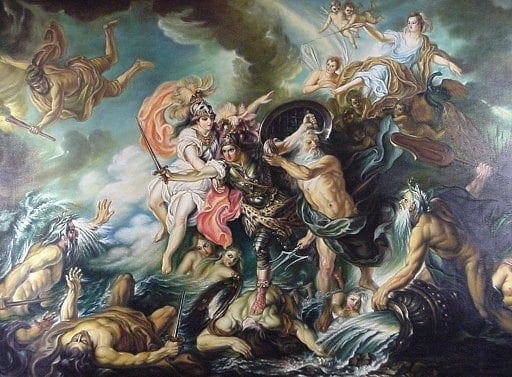
Titans and the Nephilim: From a certain Christian interpretative framework, the Greek struggle between the Olympians and the Titans is seen as a retelling of the conflict involving the Nephilim. [Genesis 6:4] mentions that “there were giants in the earth in those days; and they were there when the sons of God came in unto the daughters of men.”
The Titans, as primordial giants of immense power who preceded the current order, correlate to the Nephilim7—the hybrid offspring of fallen angels (sons of God) and humans. The “Titanomachy8,” or the war to overthrow the Titans, reflects the biblical theme of divine judgment upon these rebellious, oversized beings to cleanse the earth for a new order of righteousness.
An Ancient Lie Persists in Mythology
Connections to Gnosticism9: These themes converge in Gnosticism, which often inverted the traditional biblical narrative. Gnostics viewed the material creator (the Demiurge/Archetict, like in The Matrix10) as a flawed or evil deity and saw the “God” of the Old Testament as a jailer of the human spirit. (It is important to distinguish that Gnosticism was one of the earliest foes of the 1st-century Church.) Gnostic gospels11 are still being promoted today.
For we have not followed cunningly devised fables, when we made known unto you the power and coming of our Lord Jesus Christ, but were eyewitnesses of his majesty. [2 Peter 1:16]
In this light, Prometheus is a savior figure, a “bringer of light” (similar to the name Lucifer, meaning “light-bringer”) who liberates humanity from the ignorance imposed by a tyrannical creator. This Gnostic perspective transforms the theft of fire into a necessary act of spiritual liberation, aligning with the belief that secret knowledge (gnosis) is the only path to escaping the material prison. (Those with a Biblical Worldview see the lie of the Serpent)
- https://enduringword.com/bible-commentary/romans-1/ ↩︎
- https://paganeo.com/what-is-paganism-beliefs-practices-and-history/ ↩︎
- https://mythosatlas.com/stories/prometheus-fire ↩︎
- https://occult-world.com/lucifer-light-bearer/ ↩︎
- https://www.knowmastery.com/prometheus/ ↩︎
- https://rumble.com/vp2p2h-what-is-dualism-in-the-occult-a-gnostic-belief-movie-reviews.html ↩︎
- https://cdn.bookey.app/files/pdf/book/en/the-final-nephilim.pdf ↩︎
- https://www.greekmythology.com/Myths/The_Myths/Titanomachy/titanomachy.html ↩︎
- https://amos37.com/hollywood-gnostic-agenda/ ↩︎
- https://occult-world.com/lucifer-light-bearer/ ↩︎
- https://gnosticismexplained.org/anticosmicism-gnostic-dualism/ ↩︎