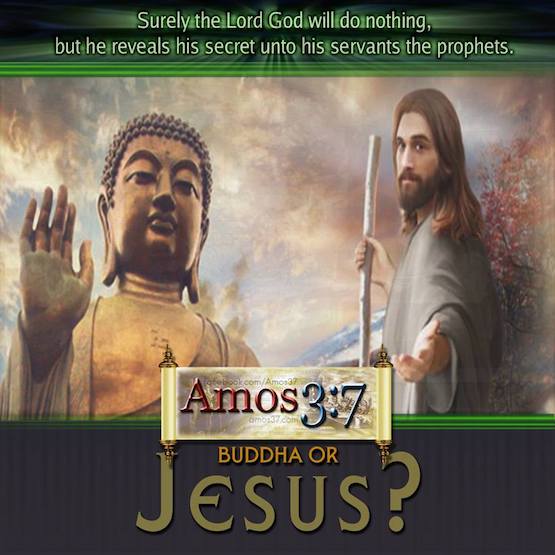
So many Americans are in a numbed condition, without confidence, empty, despondent, and hopeless. Zen offers a frustrating dead end, like lives that make no sense. Life is just one big koan! How different from Christianity! Christ gives hope! The Bible explains life’s paradoxes and mysteries that only God could know. Christians have a loving God! (excerpt from below)
Buddha or Jesus At a Glance
| Buddhism | Christianity | |
| Human nature | People are ignorant. They are attached to people and their desires. Buddha claimed he wasn’t like other normal humans because he was enlightened. | Mankind is fallen, sinful, and in need of a savior. God, in his mercy, provides a way for them to be forgiven for their sins through Jesus’ death on the cross. |
| Confessing sins | Didn’t believe in sin, but taught that desires were the root of all suffering. | If we confess our sins, he is faithful and just to forgive us our sins and to cleanse us from all unrighteousness. (1 John 1:9 ESV) |
| Beliefs | Believe in reincarnation. After death, you return to earth in a cycle of Karma. You achieve Nirvana or enlightenment, seeking to do good deeds. You are paid for it with pain and suffering if you do bad things. Buddha claimed to have reached Nirvana. | Christianity teaches Jesus is the one and only Son of God. He is the Saviour of the world. He bore the sins of all mankind. A person is saved by grace through faith in Jesus, not good deeds. |
| Bible | Buddha didn’t believe the Bible was the inspired word of God. He didn’t believe in God or observe the Ten Commandments. It’s still being determined where he got his moral views. He wasn’t against others believing in gods or idols. | Christians believe Bible is the inspired, holy word of God. |
| God | Didn’t believe in the Sovereign God of the Bible. | Teaches that God of the Bible created the heavens and the earth. He is all-knowing, all-seeing, and all-powerful. |
Speculations versus Eternal Security!
Buddhism began in the sixth century B.C. in India. Siddhartha Gautama found that neither luxury nor self-mortification brought contentment. Through meditation, he gained “enlightenment.” It is said the lotuses bloomed on every tree and the entire universe turned into a bouquet of flowers whirling through the air. He was given the name Buddha, meaning “the Enlightened One.”
How to Witness to Buddhists
Buddhism split into two schools of thought. Mahayana Buddhism emphasized the spirit of Buddha. Hinayana Buddhism emphasized his writings. Later, the two subdivided. Early Buddhism did not believe in a life after death. Today, “Pure Land Buddhism,” a major group in Hawaii, anticipates a kind of heaven.
Teachings of Buddhism: Four Sublime Truths & The Eightfold Path
Buddhism is known for its four sublime “truths” and the eightfold path.
The four sublime truths are:
- Pain is universal
- Pain is caused by desire
- The cure for pain comes through overcoming desire
- Victory can be achieved by following the eightfold path. The eightfold path leads to nirvana, the state of pure enlightenment and bliss.
The steps are:
- Right knowledge
- Right aspiration
- Right speech
- Right behavior
- Right livelihood
- Right effort
- Right mindfulness
- Right meditation.
Zen Buddhism
The last step of the eightfold path is where Zen Buddhism begins, and the rest of Buddhism stops. Zen imagination is based on Buddha’s Flower Sermon, in which he said nothing; he just held up a golden lotus. Zen Buddhists are called the “Wordless Sect,” without creed or code, and not very concerned with the Buddhist “scriptures.” They try to restore the Buddha’s original insight. They have no future abode for the dead, and no soul to be looked after.
[bctt tweet=”Buddhism is known for it’s four sublime “truths” and the eightfold path. The four sublime truths are? #zen #nirvana” username=””]
Zen Buddhism is vague and varies by teacher. One saying is “I owe everything to my teacher because he taught me nothing.” Understandably, the beatniks of the 1950’s popularized Zen in America. Now Zen centers are on the West Coast and in Hawaii. Zen teachers boast of awareness, but the religion lacks awareness of others’ needs. Christianity teaches a person to give to the needy and beggarly. The ideal in Zen Buddhism is to beg!
A thousand years later, AD 520, Bodhidharma became the father of Zen Buddhism. He took his thoughts to the Chinese emperor, who rejected them. Bodhidharma spent the next nine years “gazing at the wall.” As he grew older, he decided to look for the Western Gates of China. Last seen, he wore one sandal on his head, “scowling and lost in self-absorption.”
Zen Buddhism was accepted in China, lost support, then caught on in Japan around the 13th century. It weakened in Japan but caught on in a hopeless and rebellious American generation that rejected morality, sin, and authority. Zen teaches you to accept yourself as the Buddha and seek the Buddha by seeing into your nature (the Buddha itself). The Buddha is the person’s own mind, which becomes one with the ultimate. Like the founder, “They are without excuse: Because that, when they knew God, they glorified him not as God, neither were thankful; but became vain in their imaginations, and their foolish heart was darkened. Professing themselves to be wise, they became fools.” (Romans 1:20b-22)

Three key words help you understand the perplexities of Zen Buddhism.
“Zazen” means to “sit and meditate.” Sitting cross-legged, staring at the floor for hours and breathing deeply, the Zens try to relax the body, rid themselves of impure thoughts, and prepare for satori.
“Satori,” or the perpetual now, is uniquely Zen and differs from other forms of Buddhism. The effort is to experience “truth” immediately, not to just understand it. Satori is a sudden intuition that one has found the basic principles holding the universe together. It is a state of appreciating the original inseparability with the universe.
They meditate on a “koan”, a problem that cannot be answered logically. For example: “What is the sound of one hand clapping?” “What was the appearance of your face before your ancestors were born?” “When the many are reduced to one, to what is the one to be reduced?” Yet Zen nourishes the ego, trying to make the mind its own master. It is characterized by a revolt against authority. In the Kingdom of the Cults, Walter Martin said, “Zen Buddhism is the most self-centered, selfish system of philosophy that the depraved soul of man can embrace, for it negates the two basic principles upon which all spiritual reality exists: ‘Thou shalt love the Lord thy God with all thy heart, with all thy soul and with all thy mind…and thy neighbor as thyself” (Matthew 22:37,39).
So many Americans are in a numbed condition, without confidence, empty, despondent, and hopeless. Zen offers a frustrating dead end, like lives that make no sense. Life is just one big koan! How different from Christianity! Christ gives hope! The Bible explains life’s paradoxes and mysteries that only God could know. Christians have a loving God!
Jesus & Buddha. A pro-Buddhist source: Do they really compare when you look deeper? Works vs. Grace. Religion says “Do”; Jesus said “Done” at the cross.
Zen Buddhists Reject Any Saviors

Zen Buddhists reject any savior, apart from a way-shower, Buddha. Zen followers believe salvation is understanding your true self. They say, “We eat, excrete, sleep and get up; This is our world. All we have to do after that — Is to die.” Detached from life, they advise, “Do not seek after truth; merely cease to hold opinions.” A Zen poem says: “If you want truth to stand clear before you, never be for or against. The struggle between ‘for’ or ‘against ’ Is the mind’s worst disease.” The theory is that all of life is good and to be accepted; it is part of you, and you are a part of it.
Zen confuses the distinctions such as soul and body, right and wrong, matter and spirit, and life and death. The contradictions are clear, but the deluded do not worry about solving them. It teaches that all of life is a unity, including God and man, heaven and earth, and now and eternity. Consequently, man is not a being, but rather nothing but a bundle of sensations, thoughts, feelings, and energy, in a constant state of flux. Followers go deep into Zen and feel like an “it” rather than a personality. They need Jesus Christ, who came “that they might have life, and that they might have it more abundantly.” (John 10:10)
Is the Satori experience just as Christian conversion, like some claim? No. Real salvation comes from God. God reaches down into our dilemma as we come to realize we cannot save ourselves. Zen’s satori vainly reaches into the inner self to find the ultimate oneness.
To those lost in weary speculation, Jesus reaches out to you and invites you to, “Come unto me, all ye that labor and are heavy laden, and I will give you rest. Take my yoke upon you, and learn of me; for I am meek and lowly in heart: and ye shall find rest for your souls.” (Matthew 11:28-29) — Adapted from Those Curious New Cults, William Peterson, Keats Pub., 1975.
Nichiren Shoshu Buddhism
Nichiren Shoshu Buddhism is a mystical sect from Japan. It claims to follow the Buddha’s original teachings. The founder, Nichiren Daishonin (1222-82 AD), denounced all former Buddhist sects. He claimed to correctly interpret the Lotus Sutra, a pseudo-Buddhist writing penned at least 200 years after Buddha’s death. Yet no one can be sure what Buddha taught, since his life was clouded by myth and hearsay. Gautama would not recognize the teachings of the Lotus Sutra, which differ glaringly from early Buddhist beliefs. Gautama would not accept Nichiren Shoshu’s ideas either.
What About Chanting?
Gongyo, a ritualistic chant, is made eight times a day. The effort is to unify with the underlying essence of the universe, the life of Buddha. This goes along with the pantheistic belief that all existence is one (god is all and all is god). The syllables of the chant are in dedication and represent all the truth of the universe. What did Jesus say? “But when ye pray, use not vain repetitions, as the heathen do: for they think they shall be heard for their much speaking.” (Matthew 6:7) NSB claims to be compatible with Christianity, but it is not possible to honestly follow Jesus and any form of Buddhism.
Prayer to idols is condemned (Acts 17:24-29). Biblical prayer is not to wooden idols symbolizing karmic law, but to the God of creation, eternal and all-powerful! Idol worship is absolutely futile! (Isaiah 44:9-20). Idols are nothing compared to the Sustainer of the universe (I Cor. 8:4-6). God says to turn from religious images and to repent! (Acts 17:29-30). God’s people’s prayers matter to Him now! (Psalm< 102:17). We are not under the imaginary laws of karma, that one’s life cannot be improved until he gets rid of the bad of previous lives. Most Eastern prayer is self-centered; biblical prayer is concerned for others. (James 5:16)
What is Reality?

Like many religions, the NSB attempts to make up its own reality and truth. Rather, it cuts people off from reality as they have no way to test it objectively.
How can opposites be synonymous? Buddha’s “entity is neither being nor non-being: Neither cause nor effect; neither itself nor another…neither this nor that, past or future…” Could you base your future on a sect that imagines absolute permanent happiness while talking about retrogression to another realm? Followers leave the world of objectivity for constant uncertainty.
The end of these speculations is to say no language or thought is meaningful at all! Eastern religion talks of truth and some form of “yin and yang” — the inseparable forces of (good/bad, male/female, black/white, hot/cold, etc.). It is impossible to say “everything and nothing!” If truth and error, good and bad, are reflections of the same God, then no one can discern good or bad in anything! That is to say, the NSB is right but also wrong! Who would want to embrace a religion that is wrong?
The Creator gave us the sense to live by some absolutes. Anyone absolutely denying absolutes defeats his own position! Nichiren Shoshu attacked Christianity, saying it is inferior. Doing so, he reduced his own logic to nonsense. Obviously, Nichiren Shoshu’s followers do not understand Christianity. This makes it easy for them to reject Christ. Christians, share the truth!
NSB escapes logic! It says man is in an eternal cycle and teaches that the cycle will end for souls that reach the tenth realm, Buddhahood! NSB quotes point out man’s sinfulness, but since all is God and God is good, man is good and cannot sin! No, man is sinful (Romans 3:23) and in need of a Savior!

ONE GOD OR… Incredibly, the NSB teaches belief in a pantheistic god, polytheism (many gods), henotheism (one main god worshipped above all other gods), and atheism (no omniscient and omnipotent God)!
The Bible says the One who rose from the dead proved His identity as the God of the universe (Luke 24:39; John 20:28; I Cor. 15:14-20; Rom. 1:3-4). God always existed and always will exist as distinct from His creation (Acts 17:24; Psalm 33:6-9). God warns about those who say, “Let us go after other gods…” (Deut. 13:2-4). There are no other true Gods (Isaiah 43:10), so polytheism is condemned! (44:6,8).
NAISHONIN DAISHONIN OR JESUS CHRIST? Eastern religions acknowledge Jesus as a great teacher while rejecting His omnipotent deity. Like other religious leaders, Nichiren Daishonin said the teachings of Jesus are inferior to his. Yet Jesus claimed all power (Mat. 28:18), that He would rise from the dead, and that He would give life to anyone who trusts in Him! (John 11:26) While Jesus’ grave is empty, the grave of Nichiren Daishonin has a body like others who make man-made religions!
The Jesus of the Bible is the only Savior, God the Son, and the only way to salvation! (Acts 4:12; John 20:28,31; 14:6). Christ’s teachings are not inferior to the mystical, contradictory flashes of so-called “wisdom.” He came to set sinners free (Luke 4:18-19; 19:10)! Salvation is not mere enlightenment but trusting in Jesus Christ in order to escape condemnation (John 3:18).
Mankind was created distinctly different from the rest of creation (Gen. 1:28). Corruptible man cannot be the unchanging God (Ez. 28:2; Num. 23:19). The pagans at Lystra would worship men as God, but Paul corrected them! (Acts 14:15)

Salvation is not by recognizing your own divinity and removing the penalty of bad karma (penance, chanting, and reincarnation). We will not be absorbed into the stuff of the universe; rather, Christians look forward to “the glorious appearing of our great God and Savior, Jesus Christ.” (Titus 2:13)
None of our human “works” can save. (Ephesians 2:8-9) Salvation is offered freely but on God’s terms. Unlike the gods, the great God paid for sin Himself because of His love for mankind. (Acts 20:28) Anyone who comes to God through Christ is cleared of guilt. God took the initiative to reach out to the willful sinners of the earth. (Romans 5:8) Our own best works are only as filthy rags to an infinitely holy God. (Isaiah 64:6) The only work that counts is the work of Jesus shedding His blood to pay for sin. (John 6:29; Romans 5:9)
Nichiren Shoshu Buddhism cannot produce any genuine peace with God, eternal life, or a personal fellowship with God. The efforts of man are self-centered and insignificant compared to the eternal riches given through Jesus Christ. Why not come to the true God? Let Him meet your needs and give you the joy that lasts forever! (Matt. 6:33; Phil. 1:6)
Your destiny will not be a reincarnation, but we will face judgment before Almighty God. (Hebrews 9:27; Daniel 12:2) The good news is that you can “know” today that you will be accepted by Him if you will trust in Jesus Christ alone! (1 John 5:11-13) Jesus Christ is alive, and He offers you His personal fellowship. Why not talk to Jesus Christ in prayer today, believing that He died for you and arose alive from the dead! God does not offer you anything second best. Become a biblical Christian and your destiny will be Heaven! But to miss Jesus Christ means that God must judge you as a pagan with a definite fate of the Lake of Fire. (Psalm 9:17) — Adapted from The New Cults, Walter Martin, Regal Books, 1980
May God guide you in your search for truth! To learn more about the Jesus of the Bible, you can find caring help at the address provided. See the source link at the top of the article.



























Funniest thing I’ve read in a -long- time jccampb