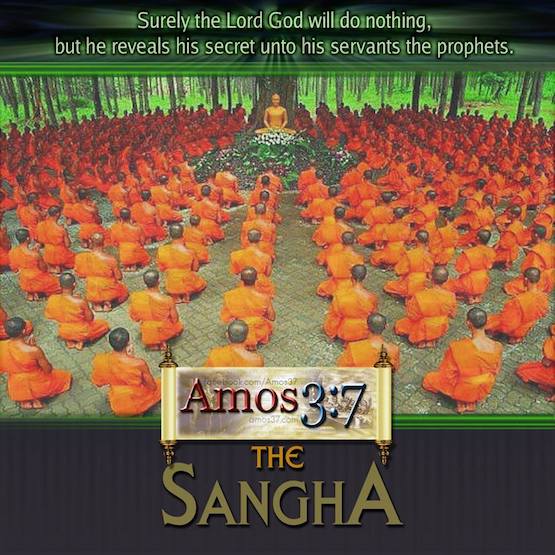
Last of 3 short articles by Contender Ministries on a short synopsis of Buddhism. The Buddha was part 1 & The Dharma was part 2. After the Buddha’s first sermon, he continued to preach only to his followers, a group of wandering beggars, rather than to the masses. These followers became the first monastic order. This order of Buddhist believers is known as the Sangha. In order to learn the Dharma and become part of the Sangha, people were required to become one of these beggar-monks.
What is The Sangha?
by Contender Ministries
Those joining the Sangha would have their head shaved to symbolize renunciation of worldly things and would be given a new name and a new robe before taking their vows. After completing a period as a novice, the monk would be given a new name and a new robe.
Buddhist Gives Explanation of the Three Jewels in Buddhism
Buddha and The Middle Way
Buddha taught the Middle Way, so monks were taught to reject worldly comforts, but they also rejected self-torture or mortification. The Buddha continually warned his disciples against the sinister guile of women, and women were not allowed in the Sangha. Indeed, it was very difficult for a woman to become a Buddhist at the time.
“Buddha and the Middle Way: An Explanation of What Christians Should Know About Buddhism. #Buddha #Sangha”
Later, Buddha allowed women to become part of his followers, but many restrictions were placed on the nuns, and they were subject to the authority of the monks at all times. The Buddha is quoted as saying, “A nun, though she be a hundred years old, must reverence a monk, rise on meeting him, salute him with clasped hands and honor him with her respects, although he may have been received into the order only that day.” Some today argue that the Buddha was only communicating at a level his followers could understand, and that he went against the male chauvinism of his culture. It is interesting that today, Buddha draws a strong following from women in the feminist movement.
Followers who chose not to become members of the order were still permitted to follow the Buddha’s teachings while living in the world; however, they would not be able to achieve nirvana or receive any of the higher fruits of the Dharma, such as inner tranquility. However, they would receive another chance at rebirth, and as a reward for following the Buddha and supporting the Sangha, they could be reborn as a beggar-monk, thus allowing them to reach nirvana in the next life.
The Three Jewels in Buddhism
After the Buddha’s death, the Sangha continued to grow and split into many groups. These groups each translated the Dharma a little differently. These groups began to form monasteries throughout India, and Buddhism was transformed from a group of wandering beggar-monks to communities of Buddhist monasteries.
From the 18 schools that emerged from these groups, three major branches of Buddhism eventually developed: Theravada (the doctrine of the elders), Mahayana (the Great Vehicle), and Vajrayana (the Diamond Vehicle). These groups make up the Buddhist community, and the Buddha, the Dharma, and the Sangha are known as the “Three Jewels” of Buddhism.
Buddhism Beliefs and Practices
Connect with Amos37
Free Resources for the growing Christian.
“But grow in grace, and [in] the knowledge of our Lord and Saviour Jesus Christ. To Him [be] glory both now and for ever. Amen.” 2 Peter 3:18
Blue Letter Bible Free Online Bible & Study Tools & Commentaries
Bible Classes College Level For Free to Enroll Track your progress.
Our Own Free Discipleship Course In Video HD.