The history of Islam is fascinating, with extraordinary growth in the years following the Prophet Muhammad. Let’s take a look at the prophet and the history of Islam up to the 20th century.
Muhammad, the prophet of Islam, is believed to be the final prophet sent by Allah to restore true Islam. Islam is taught as the original faith that Allah (God) gave to Adam as His first prophet. Noah, Abraham, Noah, Solomon, and Jesus are listed as prophets of Islam. None is greater than Muhammad according to the teachings of the Qur’an (Koran).
Found in the chapters named Surahs, which are arranged from the longest surah to the shortest. Muhammad is named as “…the Seal of the Prophets…” (Surah 33:40)
Guidelines of a Biblical Prophet
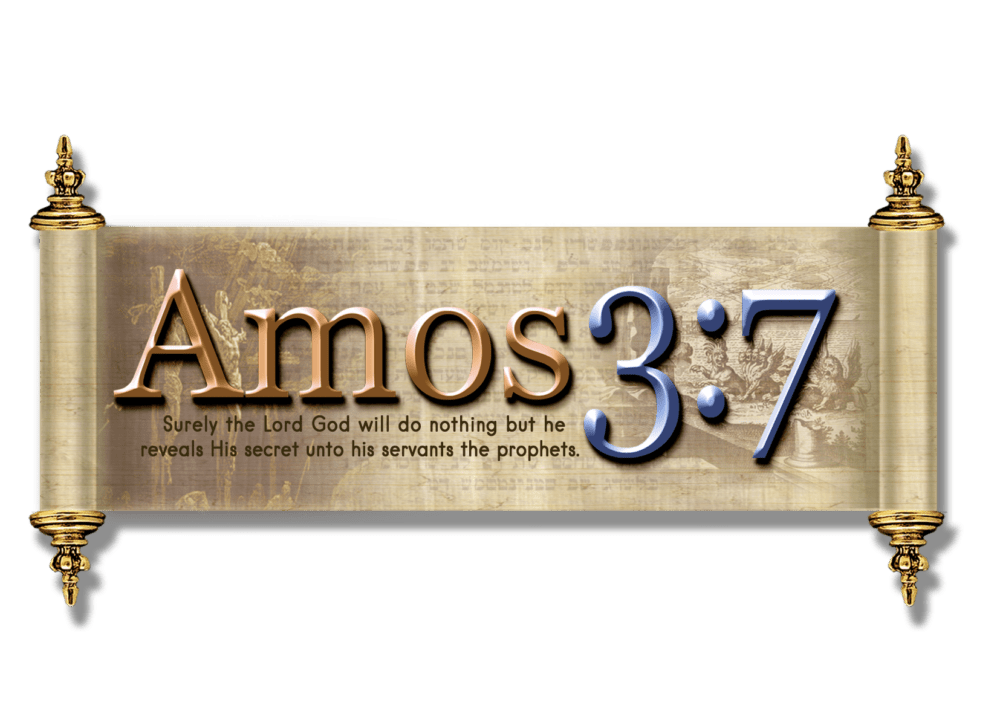
Read [Deuteronomy 18:9-22]. These verses contain the test for a prophet. Prophecy sets the Bible apart from all other religious writings. All other sacred scriptures are man-made and fail the test of the prophets.
In Isaiah 44:6-8, the LORD makes a declaration to the all peoples by showing Himself that He is the only God and there is no other!
Note in 1 Samuel 3:1-20 the process in which Samuel is called to the office of prophet vs.1 & 3. In these verses, it is the Word of the Lord that was revealed to him. In verses 17 to 19, Samuel did not withhold anything that the Lord had said and established the office of a prophet. “None of his words fall to the ground.” Vs.19
Muhammad’s rise in Mecca (The Template for Muslim Thought)
We must first go back to Muhammad and his early life before the revelations that he received.
Muhammad was born, as most believe, around A.D. 570 in Mecca. I have read some reports that his father was dead or died shortly after his birth. His father’s name was Abdollah (slave of Allah). This Allah predates Muhammad and was the chief deity in the Kaaba, which had 360 deities. One deity for each day of the year.
Muhammad’s early years were filled with tragic losses of loved ones. His mother Amina died when he was only six. His grandfather, Abd al-Muttalib, who soon died, then cared for him. Then his uncle Abu Talib took him into his care.
Muhammad was part of a very powerful tribe called the Quraysh in Mecca. Mecca is in modern-day Saudi Arabia.
At 25 Muhammad married a wealthy, influential, and older woman (40) named Khadijeh. This union of his tribal status and a well-placed wife gave him the right connections to know who was who in Mecca.
The Kaba in Mecca and The Hajj
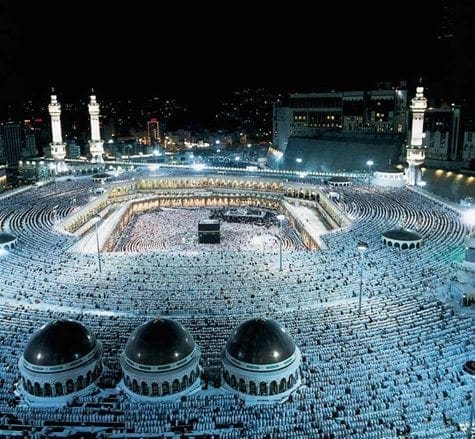
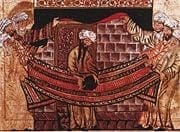
At this time period, the people of the nation worshiped many deities in the Kaaba in Mecca. The Kaaba, literally “cube,” was a cube-shaped building that held 360 idols, each representing the deity of the day. Muslims believe Adam, the first prophet, originally erected the Kaaba. Yes, the Adam of the Garden of Eden. The pilgrims would march to Mecca and walk around the Kaaba seven times, kissing and touching the Black Stone. The black stone is a meteorite to which religious meaning is given. This pagan custom of pilgrimage has been adopted by the Muslims in the pilgrimage of (hajj ). (See history of ancient Meteorite Worship)
And when the town clerk had quieted the crowd, he said, “Men of Ephesus, who is there who does not know that the city of the Ephesians is temple keeper of the great Artemis, and of the sacred stone that fell from the sky? -[Acts 19:35]
Interesting Side Note: The Kaaba is a cube; Cube Worship is found all over the world, and its symbolism is the eye of Saturn. How did the ancients come to know and move around the Kaaba in the same manner as celestial Saturn!? I submit it was fallen angels.
Muhammad questioned the worship of his day and discussed it with Jews and Christians in his area. They, however, preached of the One true God. These meetings and dialogues gave Muhammad much information about Old Testament figures, the apostles and prophets, and Jesus. It is believed that Muhammad was illiterate, and this may well be true. Accounts of Adam and Eve, the flood, and various prophets show that Muhammad did not have all the facts.
The call to be a Prophet
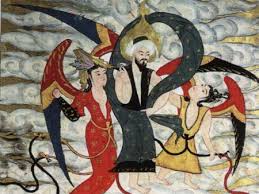
When Muhammad was 40 he was in a cave as was the custom of other religious seekers on the side of Mount Hira, some three miles north of Mecca. Around the year 610, Muhammad received a visitation he believed was from the angel Gabriel. The angel told him to recite, “Recite, in the name of the Lord who has created, created man from the clots of blood. Recite, seeing that the Lord is the most generous, who has taught by the pen, taught man what he did not know.” (Surah 96:1-5)
Interestingly enough, I found in two separate sources that Muhammad doubted the authenticity of this encounter. It is recorded that the angel had to tell the prophet three times, finally choking Muhammad, before he began to recite the verse given. Still unsure, he shared the revelation with his wife, who assured him that the call to be a prophet was genuine. When he received these revelations, he sometimes saw an angel, sometimes only heard a voice, and as he recited these verses, others wrote them down on virtually anything available. Parchments, leather, leaves, bones, and scraps were used to write down the verses.
Muhammad presented himself as a prophet to the Christian and Jews of his time and was found to be a false prophet according to the test of a prophet. See Deuteronomy 8:22 and also 1 Corinthians 14:29. Up to that point, the revelations of the prophet were quite favorable “to the people of the book”.
This is a good place to emphasize the significance that both angels and prophets hold in Islam. Muslims believe that since Adam there has been a prophet to every people to keep them on the road to true Islam. That there is one God, and that is Allah, and lastly that Muhammad is his prophet. All the ancient prophets preached the same message from Adam, Moses, Noah, Jesus, and Muhammad; all were, in fact, Muslims. Angels are given a high profile but are not worshipped, as Gabriel was the messenger who called Muhammad to his office.
The bible warns us of false prophets, false gospels, another Jesus, and angels who preach not the truth. We are warned that “And no wonder! For Satan himself transforms himself in an angel of light.” 2 Corinthians 11:14. With any knowledge at all these early believers were able to reject Muhammad’s claim. Revelations about his encounters with the Jews and Christians are found in (Surah 6:154,156), (Surah 5:68,70), and the belief in the same God. (Surah 10:90,94).
These verses from the Qur’an say that the gospel and the Jewish scriptures should be followed, yet they contradict both. Later revelations call these scriptures to be followed, but they are later told to be corrupt. This is probably due to the many contradictions between Allah and the God of the Bible.
Other revelations came to Muhammad as he fell on tough times early in his ministry. While being rejected as a prophet by the Jews and Christians, he was also rejected by the people of Mecca for his preaching of the One true God. With the loss of his wife and uncle who raised him and rejection everywhere, Muhammad decided to move to Yathrib a city 280 miles north of Mecca. This would become Medina (the city of the Prophet). This migration also holds significance for Muslims. September 24, 622, is the beginning of the Muslim Calendar, and the migration is called Hijra.
Two years into his stay in Medina, tough financial times fell on Muhammad and his followers. Then another revelation: “O Prophet, strive hard against unbelievers and be firm against them.” (Surah 9:73). Muhammad made his first military campaign against a caravan of his enemies, taking 350 men against 1000 men. Laying an ambush against them in the Battle of Badr, he defeated his enemies, and this solidified his belief that Allah was indeed with him.
He began to persecute the Jews who knew that the prophet was to come from the lineage of David. As tension increased, he assassinated some of the Jews, and they attacked several Jewish villages. This set the stage for those who follow his teachings and life decisions. The Qur’an is the very word of God to a Muslim, and the Hadith is the teachings and sayings of Muhammad written by his contemporaries.
The very actions, whether we agree or not, of the Muslim who adheres to the teachings found in their books will strive to accomplish the same way the prophet did. In the battle of Banu Quraiza, Muslim forces massacred some 1000 Jewish men. Women and children were sold into slavery, and the spoils were divided among the soldiers.
In the year 628, in the sixth year of Hijra. Muhammad made a treaty with the Quraysh tribe in Mecca, his hometown, where he made pilgrimage to the Kaaba, as was already the custom of the people. However, Muhammad’s insistence on one true God was not very well accepted, and tensions grew over those pilgrimages. A ten-year peace treaty was brokered between the two groups. After only two years, however, Muhammad attacked a people he had made peace with, took the city, purged the Kaaba of all the idols, and established himself as a political, religious, and economic force in Arabia. Mecca became, and still is, the center of Islam.
Why Islam is at War with Everyone
Another revelation came to Muhammad. “Let there be no compulsion in religion” (Surah 2:256) to “kill those who join other gods” (Surah 9:5). Many tribes in Arabia were forced to convert to Islam (which means submission to Allah) and to Muhammad.
Only four years later, in the tenth year of Hijra, Muhammad died in 632 after an illness without leaving a successor. This vacuum brought a violent struggle for power and leadership of the way this new religion should go.
Muhammad’s successors are called Caliphs (kind of like popes). Historically, they were more political than spiritual. The first caliph, Abu Bakr, brought the Arabian Peninsula under Islamic rule through military conquest. These tribes were divided, and many saw the death of Muhammad as a way of escaping the submissive nature of the religion and political system that came from it.
The second caliph, Omar (633-644) was a great military man defeating the empires around and beginning the great expansion of Islam. For about 100 years, Islam expanded under the sword of submission. Islam spread across Asia, across Arabia, into northern Africa, and was spreading into Europe. Spain was mostly under Islamic rule until, in France, Charles Martel stopped the spread of Islam at the Battle of Tours in 732. Within 100 years of Muhammad’s death, Islam and its ruling law had spread over the Middle East, Egypt, Africa, and Asia.
Islam Splits with Assassination of Caliph
Division occurred within Islam at the assassination of Othman, the third caliph, in 656. Civil war and tension that still exist today over the direction and leadership of Islam are marked right here.
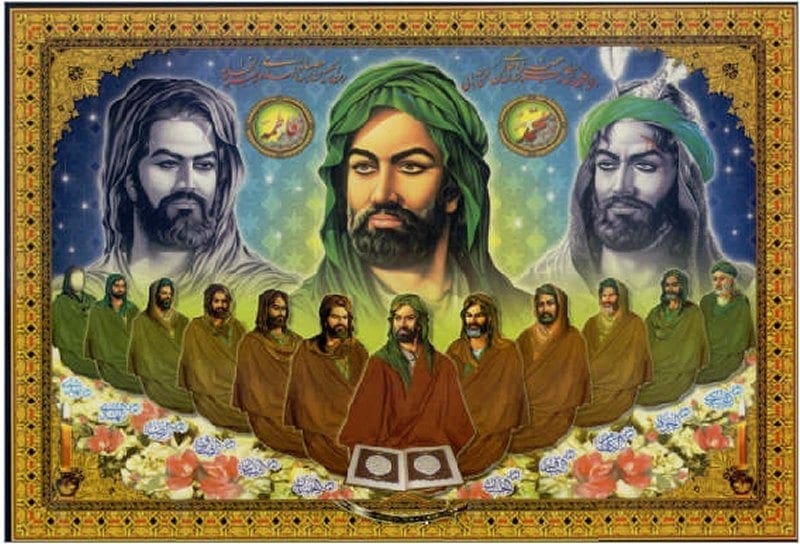
A Sunni Muslim (representing about 80% of Muslims) accepts the principle of elected leadership after the death of Muhammad and accepts the first three caliphs, rather than the blood descent that the Shiite Muslim holds to. This has caused much division and bloodshed. The claim is made by the Shiites that the first three caliphs had cheated the rightful successor, Ali ibn Abi Talib. Ali was the first imam (leader or successor) who married Muhammad’s favorite daughter, Fatimah.
This marriage brought Muhammad’s grandsons Hasan and Husayn. During Ali’s rule as the fourth caliph entered into a struggle over rule and was eventually murdered by followers who felt alienated by political dealings over power. Ali’s son Hasan was chosen by the Shiites, and the Sunni branch of Islam chose a wealthy leader of the Umayyads outside the Prophet’s family.
Hasan, the Shiites’ successor, was the grandson of Muhammad, but he resigned and was then actually murdered. His brother Husayn became the new leader (Imam), but the other Sunni Umayyad Muslims killed him too. His death is seen as martyrdom to the Shiites. The Shiites see the imams as infallible teachers with “the divine gift of impeccability. Most adhere to the belief that there were only 12 true imams.
Every year the Shiite Muslims commemorate the martyrdom of Husayn with processions and even inflict themselves with swords. Reminds me of the Baal priests cutting themselves when confronted by Elijah. Shiites comprise only 20% of Muslims in the world. Iran and the Ayatollah Khomeini were Shiite and began a fundamental revival of Islam in Iran in the 1980s. To this day, it casts its specter over the world.
With this brief history of the spread and origin of the Islamic faith, one can see the bloody hand of double-dealing and treachery at every turn. We have noted that history shows a pattern of false peace treaties, murder, and invasions. Division and wars still seen in Afghanistan and many of the Islamic nations are a powder keg of internal feuding over political and religious ideology.
How to Witness to Muslims
Muslims need Jesus. They are not the enemy, but are captives of the enemy. Taken by the enemy to do his will. It is a spiritual battle. There is a war in heaven! We have many things here we discuss on the error of Islam in light of God’s glorious gospel. However, God wants us to share His Son, who loved them and died for them also. It is a war between the forces of light and the satanic forces of darkness. See Revelation 12:7 and Daniel 10 for this heavenly battleground.
We as Christians once walked in darkness Ephesians 5:8-11, but now are children of the light. God loves the Muslim, and yes, Jesus died for my sins and theirs.
Take the Good Person Test
“He who hears My word and believes in Him who sent Me has everlasting life, and shall not come into judgment, but has passed from death into life.”
Play
Pray This Prayer and believe on the Lord Jesus Christ:
"Dear Lord Jesus, I know that I am a sinner, and I ask for Your forgiveness. I believe You died for my sins and rose from the dead. I turn from my sins and invite You to come into my heart and life. I want to trust and follow You as my Lord and Savior. -Amen
The Good Files is broken into Three Learning Tracks: each topic includes an introduction and a list of PDF files with links. Just click or tap images to go to new articles. Like what you saw, leave a comment, and rate the content of this article. Most of these will update frequently and allow you to download a large amount of World News Updates, Prophetic Discernment, and Biblical Separation Series.The Good Files – A Look Behind The News
Used to monitor number of Google Analytics server requests when using Google Tag Manager
1 minute
_gid
ID used to identify users for 24 hours after last activity
24 hours
_ga_
ID used to identify users
2 years
_gali
Used by Google Analytics to determine which links on a page are being clicked
30 seconds
_ga
ID used to identify users
2 years
__utmx
Used to determine whether a user is included in an A / B or Multivariate test.
18 months
__utmv
Contains custom information set by the web developer via the _setCustomVar method in Google Analytics. This cookie is updated every time new data is sent to the Google Analytics server.
2 years after last activity
__utmz
Contains information about the traffic source or campaign that directed user to the website. The cookie is set when the GA.js javascript is loaded and updated when data is sent to the Google Anaytics server
6 months after last activity
__utmc
Used only with old Urchin versions of Google Analytics and not with GA.js. Was used to distinguish between new sessions and visits at the end of a session.
End of session (browser)
__utmb
Used to distinguish new sessions and visits. This cookie is set when the GA.js javascript library is loaded and there is no existing __utmb cookie. The cookie is updated every time data is sent to the Google Analytics server.
30 minutes after last activity
__utmt
Used to monitor number of Google Analytics server requests
10 minutes
__utma
ID used to identify users and sessions
2 years after last activity
_gac_
Contains information related to marketing campaigns of the user. These are shared with Google AdWords / Google Ads when the Google Ads and Google Analytics accounts are linked together.
90 days
WPMU DEV Analytics is the visitor statistics feature of the WPMU DEV Dashboard plugin. It reports traffic and visitor behavior inside The Hub using a Matomo analytics instance hosted by WPMU DEV.

 When Muhammad was 40 he was in a cave as was the custom of other religious seekers on the side of Mount Hira, some three miles north of Mecca. Around the year 610, Muhammad received a visitation he believed was from the angel Gabriel. The angel told him to recite, “Recite, in the name of the Lord who has created, created man from the clots of blood. Recite, seeing that the Lord is the most generous, who has taught by the pen, taught man what he did not know.” (Surah 96:1-5)